Name the question correctly
Allergen cross-contact is the unintended introduction of an allergen into food that would not otherwise contain it. It can happen during manufacturing, storage, preparation or service. It is different from finding an intentional ingredient in a recipe, although both questions may matter for the same food. Keeping the two questions separate makes it easier for a food business to give a meaningful answer.
A recognition tool generally sees a surface, a label or a menu. It cannot inspect what was stored above an open container, whether a spoon was moved between dishes, or how equipment was cleaned. Even a detailed photograph of a kitchen shows only one moment. Do not infer a preparation history from the visual neatness of a worktop or a model’s confident description of it.
Follow the route through preparation
Begin with ingredients arriving at the business. Ask whether bought-in components have current supplier information and whether substitutes are checked. Then consider storage: open containers, shared scoops, decanting and incorrect labels can disconnect the food from its original information. These are operational questions that need someone familiar with the actual business, not a generic account of how kitchens usually work.
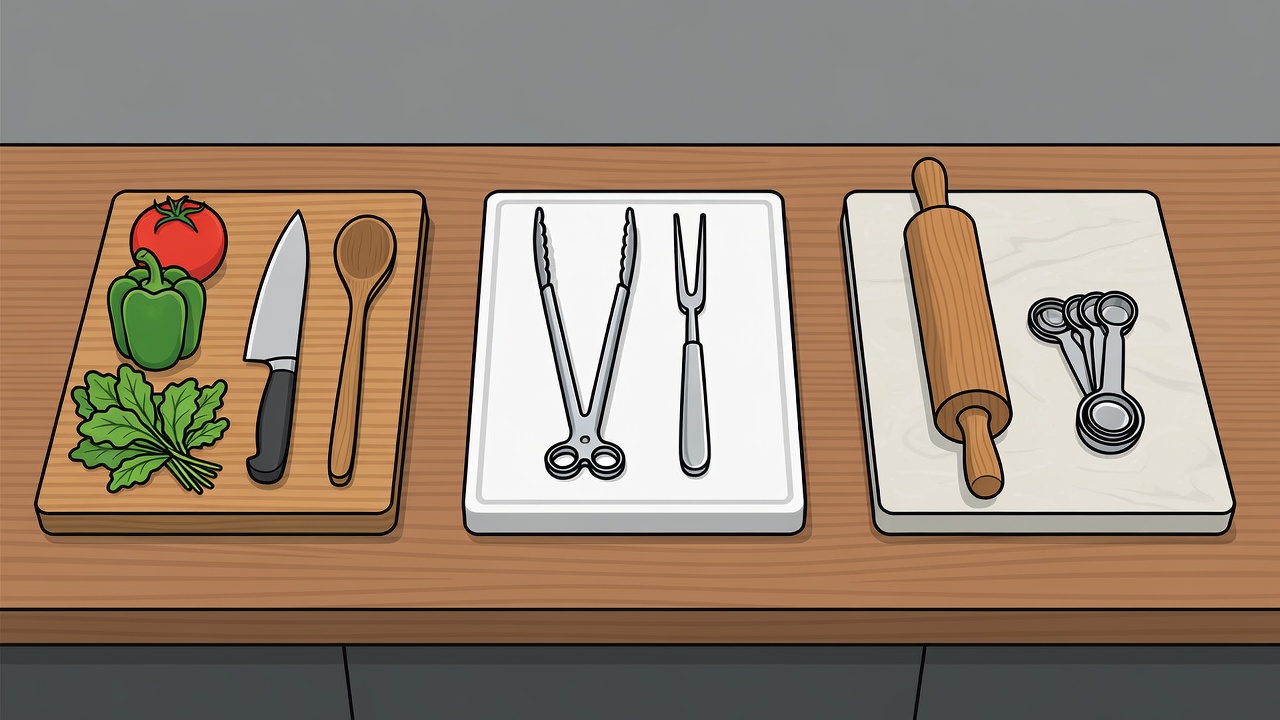
During preparation, ask about shared chopping boards, knives, mixers and work surfaces. During cooking, relevant questions may include fryer oil, grills, pans or cooking water. During service, think about tongs, serving spoons, toppings and plate identification. You do not need to recite every possible scenario; identify the stages that apply to the food and the allergen you are discussing.
Ask what “separate” and “clean” mean
Words such as “separate,” “fresh” and “clean” can describe very different arrangements. A separate serving spoon may be helpful, but it does not answer whether the food was prepared in shared equipment. A fresh batch may still use the same mixer. Ask which steps are separated and what the staff member has checked before interpreting the answer.
Cleaning procedures must be appropriate to the allergen and the setting. Do not assume that wiping a visible crumb away removes allergenic material, or that normal cooking reliably eliminates food allergens. Heat affects different proteins differently and is not a general solution to cross-contact. This website does not validate a cleaning method or equipment arrangement; that requires competent assessment of the actual process.
Recognise where service changes the picture
Self-service counters, buffets and shared condiment stations can introduce uncertainty after food leaves the kitchen. Utensils may be swapped, food may spill and diners may move items between containers. An ingredient sheet can remain accurate about the recipe while failing to describe what happened at the serving point. Ask what controls apply at the time you will be served.
Takeaway packing also deserves attention. Ask whether the intended item is identified clearly and whether sauces or sides are packed as discussed. An order note, label or separate bag can help communication, but none proves how the food was prepared. If the delivered item differs from what was agreed, seek clarification instead of using an image recogniser to decide that the difference is harmless.
Do not turn uncertainty into a probability
Businesses sometimes describe a kitchen as “low risk” or say they have “never had a problem.” Those statements do not, on their own, explain the relevant ingredients and controls. Ask for the underlying facts. A tool should not translate a vague assurance into a percentage or colour-coded clearance unless it has valid evidence for that use; a general-purpose model does not obtain such evidence from a menu scan.
Precautionary wording on a packet also does not provide a simple numerical ranking. Its presence signals a question about possible unintended presence, while its absence is not universal proof that no cross-contact can occur. Decisions about personal tolerance, avoidance and emergency planning belong with your clinician’s advice, not a website checklist or an estimated confidence score.
When you finish the conversation, write down what was confirmed, who checked it and which points remain unresolved. You may need another source, a different item or a different arrangement. Keep your prescribed medication and emergency plan in mind as advised by your clinical team. If a suspected severe reaction occurs, act on that plan and seek emergency help rather than spending time analysing the meal with software.